How to do your Spanish tax declaration for non residents – Modelo 210
Your Step-by-Step Guide to Using EasySpanishTax
Filing your Spanish non-resident property tax does not have to be complicated.
At EasySpanishTax.com, we have made the process simple, secure and easy to understand. Whether you own a holiday home in Spain, rent out your property or share ownership with your partner, our online system guides you through the information needed to prepare your Modelo 210 tax declaration.
Follow this guide to complete your declaration in just a few simple steps.
Choose the Correct Tax Declaration
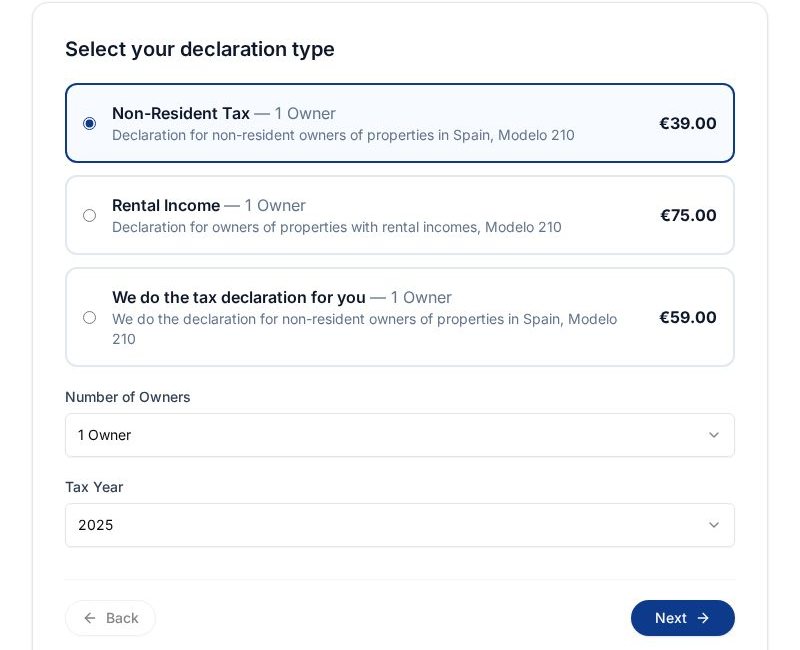
Click Start Modelo 210 Declaration and choose the service that applies to your situation.
Non-Resident Property Tax, Modelo 210
Select this option if you own a property in Spain that is used for personal holidays, stays by family or friends, or is otherwise available for your own use and not rented out.
Rental Income Tax, Modelo 210
Select this option if you receive income from renting your Spanish property, whether through holiday rentals or longer-term tenancy agreements.
If you rent out your property for only part of the year, you may need to declare both the rental income and the imputed income for the days when the property was not rented.
We Do the Tax Declaration for You
Prefer someone else to handle the paperwork? Select our assisted service, and our team will prepare your declaration using the information you provide.
Number of owners and tax year
On the same page, select how many people own the property and the year for which you want to submit the declaration. For example, if you are declaring imputed property income for 2025, select 2025 as the tax year.
For non-rented property, the declaration is normally submitted during the calendar year following the tax year.
Important: Rental income may have different reporting periods and deadlines depending on the year concerned and the applicable filing rules. Always check that you have selected the correct tax year before continuing.
Screenshot from the EasySpanishTax form Enter Your Personal Information
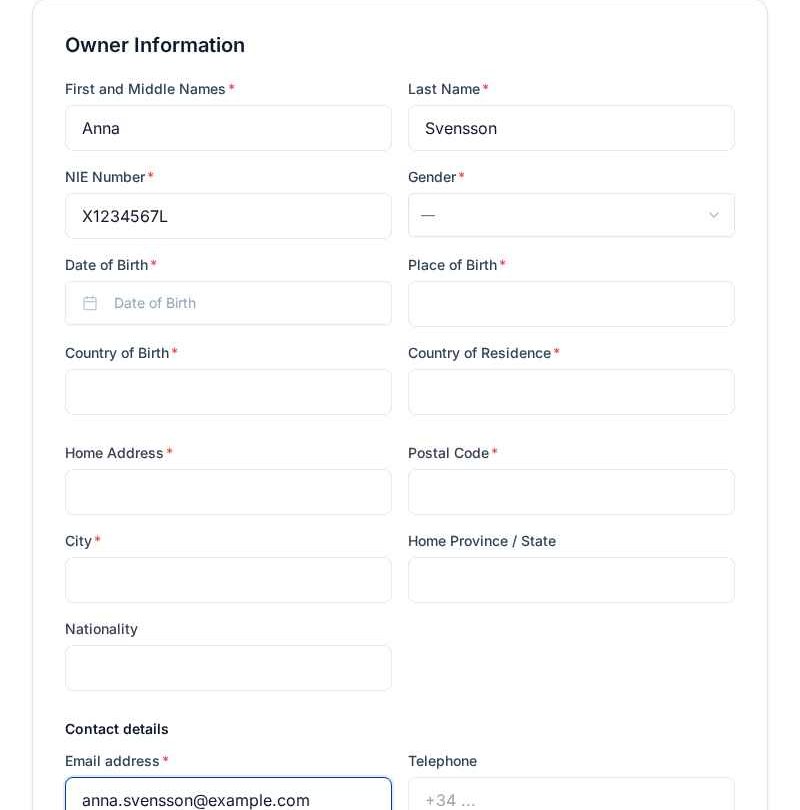
The next step is to provide your personal details. You may be asked to enter:
- Full name, exactly as shown on your identification documents.
- NIE number, your Spanish foreigner identification number.
- Country of tax residence.
- Residential address outside Spain.
- Email address and contact details.
Important: Make sure your NIE number and name are entered correctly. Incorrect information may cause problems when preparing or submitting your tax declaration.
Ownership share
If you own your Spanish property together with another person, enter the details of each owner and indicate the ownership percentages. For example:
- One owner: 100% ownership.
- Two equal owners: 50% each.
- Three owners: Enter the percentage belonging to each owner.
Each non-resident owner normally needs a separate Modelo 210 declaration for their share of the taxable income. Make sure the ownership percentages match the Spanish title deed, Escritura.
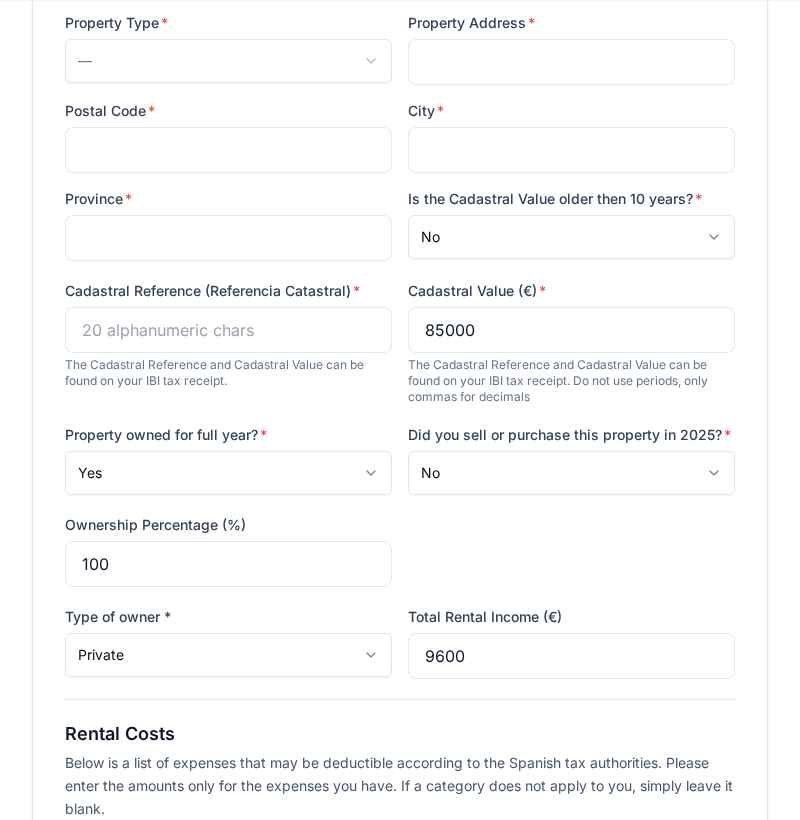
Screenshot from the EasySpanishTax form Enter Your Spanish Property Details
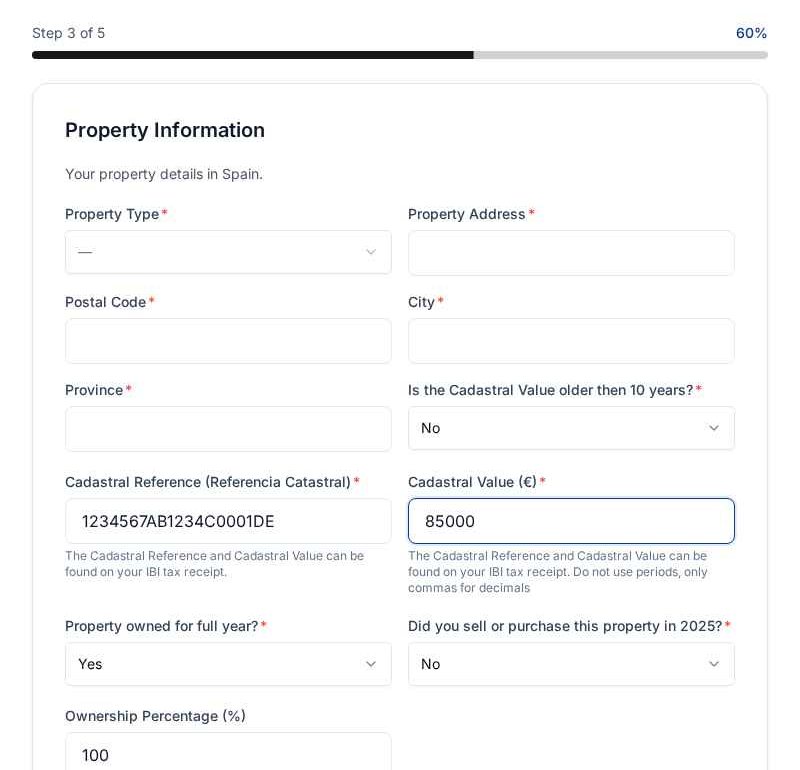
You will now need to provide information about your property in Spain. Have your latest IBI receipt available before starting. You may need the following information:
Property address
Enter the full address of your Spanish property, including the street, building, apartment number, postcode, municipality and province.
Cadastral reference, Referencia Catastral
This is the unique identification number assigned to your property by the Spanish Cadastre. You can normally find it on your IBI receipt or your property documentation.
Cadastral value, Valor Catastral
The cadastral value is the official administrative value assigned to your property. It is used to calculate certain Spanish property taxes. You will normally find it on your annual IBI receipt.
Do not confuse the cadastral value with the market value or the price you paid for your property.
Tip: If you are unsure where to find these details, visit our help article, Cadastral Number and Cadastral Value.
Your estimated tax
If your property is not rented out, your tax is generally calculated using its cadastral value. At the bottom of this page you will see your estimated tax. The calculation takes into account factors such as:
- The cadastral value of the property.
- The applicable imputed income percentage, normally 1.1% or 2%.
- Your ownership percentage.
- The number of days the property was owned or available for personal use.
- Your tax residence and applicable tax rate.
The general non-resident income tax rate is 19% for qualifying EU, Icelandic and Norwegian residents, and 24% for other non-residents, subject to applicable rules.
You can also use our Free Modelo 210 Calculator to estimate the amount before starting your declaration.
Screenshot from the EasySpanishTax form 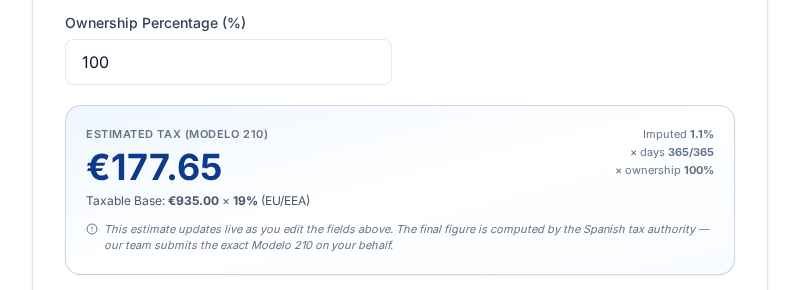
Screenshot from the EasySpanishTax form Complete Your Rental Income Information
If you rent out your Spanish property, you will need to enter details of the rental income received during the relevant tax period. Prepare the following information:
Total rental income
Enter the gross rental income received from guests or tenants.
Rental period
Provide the dates or number of days your property was rented out.
Deductible expenses
Depending on your tax residence and the applicable tax rules, certain expenses directly connected with the rental activity may be deductible. These may include eligible portions of agency fees, maintenance, insurance, community fees, IBI and other qualifying expenses.
Not all non-residents are entitled to deduct expenses, and not every property expense is automatically deductible.
Important: Keep invoices and supporting documentation for all expenses claimed. If your property was rented for only part of the year, the remaining days may also give rise to imputed non-resident property income.
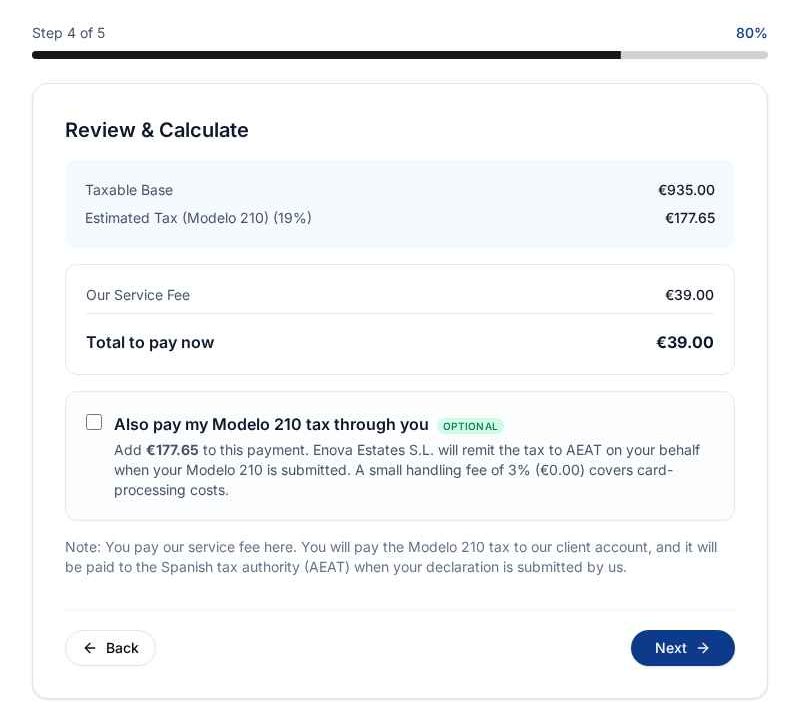
Screenshot from the EasySpanishTax form Review Your Declaration
Before continuing to payment, carefully review the information entered. Check that your name, NIE number, property address, cadastral reference, ownership percentage, tax year, income and expenses are correct.
Pay particular attention to the cadastral value and the selected tax year, as these can affect the final calculation. If you discover an error, return to the relevant section and correct it before proceeding.
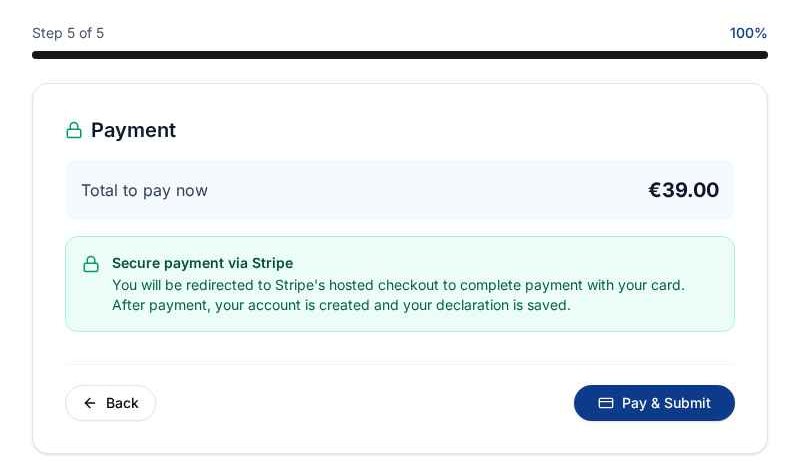
Screenshot from the EasySpanishTax form Pay Securely Online
Once your information has been completed and reviewed, proceed to the payment section. EasySpanishTax uses Stripe for secure online payments. The service operates on a pay-per-declaration basis, without subscriptions or automatic recurring charges.
Please note: The EasySpanishTax service fee and any Spanish tax payable to the Spanish Tax Agency, Agencia Tributaria, are separate amounts.
Screenshot from the EasySpanishTax form Receive Your Declaration Confirmation
If you rent out your Spanish property, you will need to enter details of the rental income received during the relevant tax period. Prepare the following information:
Total rental income
Enter the gross rental income received from guests or tenants.
Rental period
Provide the dates or number of days your property was rented out.
Deductible expenses
Depending on your tax residence and the applicable tax rules, certain expenses directly connected with the rental activity may be deductible. These may include eligible portions of agency fees, maintenance, insurance, community fees, IBI and other qualifying expenses.
Not all non-residents are entitled to deduct expenses, and not every property expense is automatically deductible.
Important: Keep invoices and supporting documentation for all expenses claimed. If your property was rented for only part of the year, the remaining days may also give rise to imputed non-resident property income.
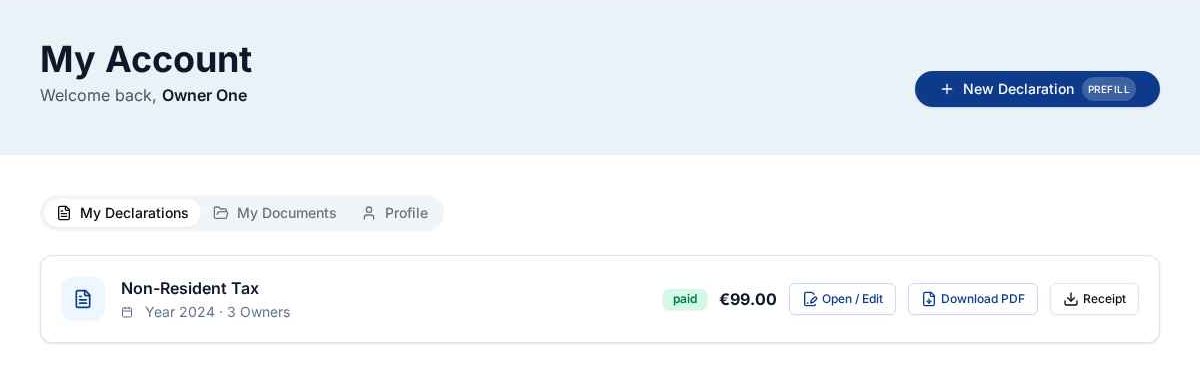
Access Your Account and Saved Declarations
One of the benefits of EasySpanishTax is that your account is created automatically and your declaration information is saved for future use. When you return to prepare your next declaration, your previously entered details can be reused.
You should still review your information every year, particularly if you have changed address, sold part of the property, changed ownership percentages or started renting it out. This makes completing your future declarations faster and easier.
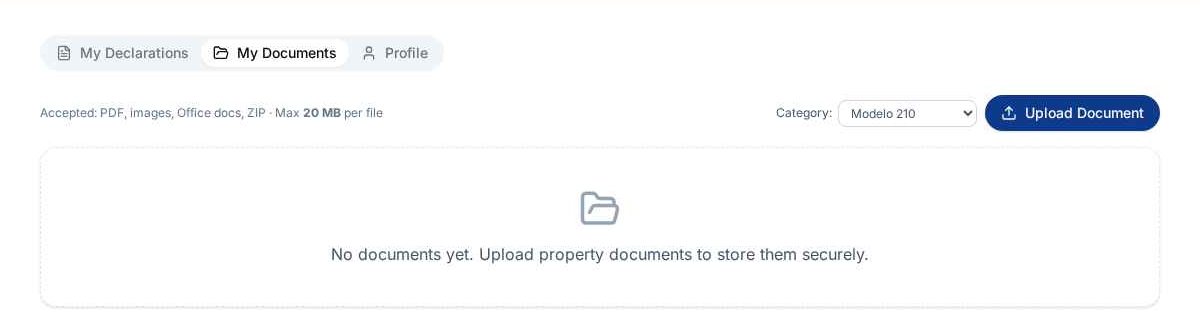
Screenshot from the EasySpanishTax form Store Your Spanish Property Documents
Your EasySpanishTax account also includes a secure document storage feature. You can keep important property documents together, including:
- Spanish title deeds, Escritura.
- IBI receipts.
- Insurance policies.
- Utility contracts.
- Mortgage documents.
- Other relevant property paperwork.
This helps you keep everything organised and accessible whenever you need it.
Screenshot from the EasySpanishTax form
Frequently Asked Questions
- Do I need to file Modelo 210 if I do not rent out my property?
- Generally, yes. If you are a non-resident individual who owns an urban property in Spain for personal use, you will normally need to declare imputed property income through Modelo 210, even if you receive no rental income.
- Do my husband and I need separate declarations?
- Generally, yes. If you both own the property, each non-resident owner normally submits a separate declaration based on their ownership percentage.
- Where can I find my cadastral value?
- You can normally find it on your annual IBI receipt under Valor Catastral.
- Can I complete my tax declaration from another country?
- Yes. EasySpanishTax is an online service designed for non-resident property owners, so you can complete the process from abroad.
- Can I use EasySpanishTax every year?
- Yes. Your saved account and declaration information make it easier to prepare subsequent years' declarations.
- What if I have made a mistake?
- If you notice an error before completing your declaration, correct it before proceeding. If you discover a mistake after submission, contact our support team to discuss the next steps. A correction or additional filing may be necessary.
- What if I need assistance?
- Our team is available to help if you experience difficulties with the online forms or are unsure how to proceed. Email: easyspanishtax@enovaestates.com · Telephone: +34 951 273 680
Ready to Complete Your Spanish Tax Declaration?
Take the stress out of Spanish property taxes. With EasySpanishTax, you can complete your Modelo 210 information online, securely and without complicated paperwork.