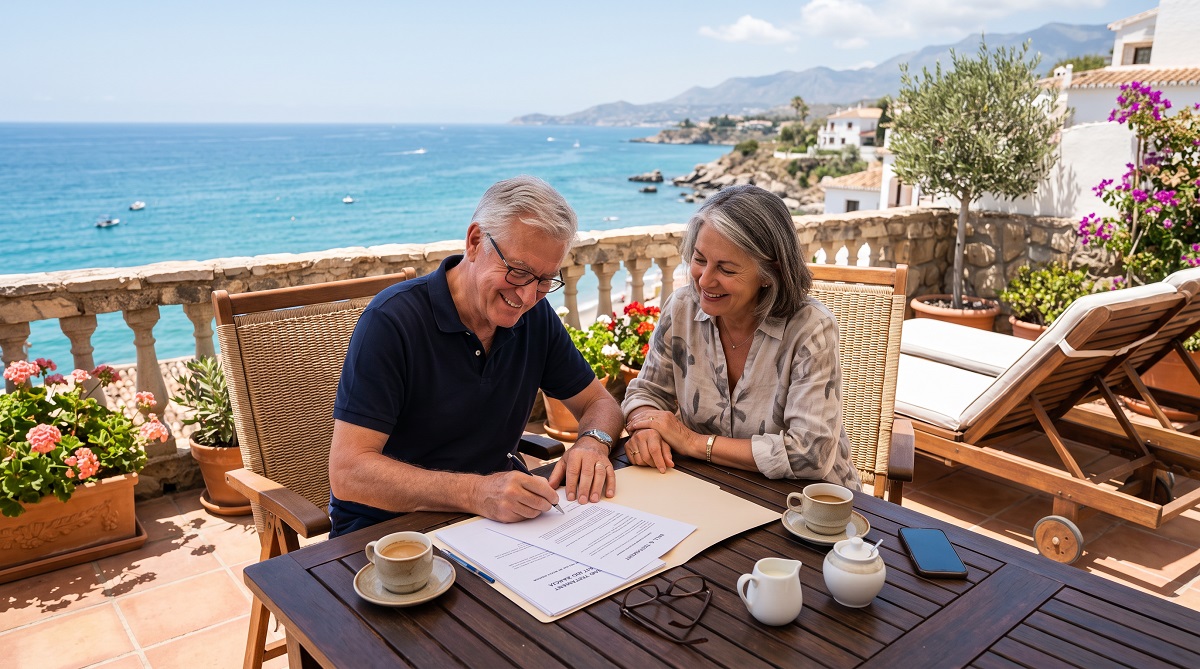
Owning a property in Spain is a dream come true for many foreigners. Whether you have purchased a holiday apartment on the Costa del Sol, a retirement villa in Alicante or an investment property in Mallorca, owning Spanish real estate brings responsibilities that go beyond paying property taxes and maintaining your home.
One important consideration that many foreign property owners overlook is what happens to their Spanish property when they pass away.
Will your spouse automatically inherit your home? Can your children inherit your Spanish property without complications? Will your family have to pay inheritance tax in Spain? And do you really need a Spanish will if you already have one in your home country?
These are important questions, particularly for non-resident property owners.
The good news is that preparing a Spanish will can make the inheritance process significantly easier for your loved ones, helping them avoid unnecessary delays, additional expenses and potential legal complications.
In this guide, we explain why having a Spanish will is recommended, how inheritance works in Spain and what foreign property owners should know about Spanish inheritance tax.
1. What Is a Spanish Will?
A Spanish will, known as a testamento, is a legal document that establishes how your assets should be distributed after your death.
For foreign property owners, a Spanish will is often prepared specifically to cover assets located in Spain, such as:
Apartments, villas and other Spanish properties.
Spanish bank accounts and savings.
Vehicles registered in Spain.
Investments and other assets held in Spain.
The most common type is an open notarial will, signed before a Spanish notary.
Once signed, the will is retained in the notarial records, and its existence is recorded in Spain's Central Registry of Wills (Registro General de Actos de Última Voluntad).
This makes it easier for your beneficiaries to locate the will when needed.
2. Why Is It Recommended to Have a Spanish Will?
Although having a Spanish will is not legally compulsory for foreign property owners, there are several important advantages.
It Makes the Inheritance Process Easier
If you die without a Spanish will, your heirs may need to rely on a foreign will or establish their inheritance rights through additional documentation.
This can involve obtaining documents from your home country, arranging certified translations and meeting Spanish legal requirements.
Having a properly drafted Spanish will can reduce these complications and make the process more straightforward.
It Can Save Your Family Time and Money
Inheritance procedures can already be stressful for grieving families.
A Spanish will can help reduce the need for additional legal documentation, translations and administrative work.
This can be particularly beneficial when beneficiaries live outside Spain and are unfamiliar with Spanish procedures.
It Helps Protect Your Wishes
A carefully drafted will identifies your intended beneficiaries and explains how you wish your estate to be distributed, subject to the applicable inheritance law.
This is particularly important for unmarried couples, blended families and property owners with children from previous relationships.
It Reduces Uncertainty
Without clear estate planning, family members may face disagreements about inheritance rights or the distribution of property.
A Spanish will provides clarity and helps avoid unnecessary disputes.
The main advantage is peace of mind: knowing that your family will have clearer instructions when dealing with your Spanish assets.
3. How Does Inheritance Work in Spain?
Spanish inheritance law can be different from the rules in your home country.
One of the most important differences concerns who has the legal right to inherit.
Under Spain's common civil law, certain family members, particularly children, have protected inheritance rights. This is known as legítima, often referred to as forced heirship.
Generally, where Spanish common civil law applies, two thirds of an estate are reserved for descendants, although specific rules govern how these portions can be distributed.
However, Spain has several regional inheritance systems, including those in Catalonia, the Balearic Islands, Galicia and other regions.
The applicable rules therefore depend on individual circumstances.
For foreign nationals, there is another important consideration: you may be able to choose the inheritance law of your country of nationality instead of Spanish law.
4. Can Foreign Property Owners Choose Their Home Country's Inheritance Law?
Yes, and this is one of the most important reasons to obtain professional advice when preparing a Spanish will.
Under EU Regulation 650/2012, which has applied since 17 August 2015, individuals can generally choose the inheritance law of their country of nationality to govern their succession.
For example:
British property owners: A British national living in Spain may choose the applicable law of their nationality, which can be particularly important when planning inheritance arrangements for a spouse or children.
Swedish property owners: A Swedish national may choose Swedish inheritance law to govern their succession.
German property owners: A German national may choose German inheritance law.
Norwegian property owners: Norwegian nationals can also make a choice of Norwegian law under the EU succession rules applied in Spain, even though Norway is not an EU member.
Without a valid choice of law, the general rule is that the law of the country where the deceased was habitually resident at death applies.
This means a foreign national permanently living in Spain could find that Spanish succession law applies to their estate unless appropriate arrangements have been made.
Ireland and Denmark do not participate in the EU Succession Regulation, but Spanish authorities apply its conflict-of-law rules to relevant cross-border estates, including choices of nationality law.
A choice of inheritance law does not eliminate Spanish inheritance taxes or override Spanish property registration requirements.
5. Do You Need a Spanish Will If You Already Have a Will in Your Home Country?
Not necessarily, but having a separate Spanish will is often recommended.
A valid foreign will can generally be recognised in Spain, provided it satisfies the applicable legal requirements.
However, using a foreign will may involve additional paperwork, including:
Obtaining official copies of the will.
Providing proof of its validity and applicable succession law.
Arranging sworn translations into Spanish.
Obtaining an apostille or other authentication where required.
Coordinating with legal representatives in different countries.
Having a Spanish will dealing with your Spanish assets can simplify this process.
Important: If you have wills in two countries, they must be carefully coordinated.
A new Spanish will should not accidentally revoke your existing foreign will, and both documents should be drafted to work together.
A lawyer experienced in international inheritance law can help ensure this.
6. What Happens to Your Spanish Property When You Die?
When a property owner dies, their Spanish property does not simply transfer automatically into the names of their beneficiaries.
The heirs generally need to complete a legal inheritance procedure.
The process usually involves the following stages:
Step 1. Obtain the death certificate
An official death certificate must be obtained. Foreign certificates may require translation and authentication.
Step 2. Locate the will
A Spanish Certificate of Last Wills (Certificado de Últimas Voluntades) establishes whether a Spanish notarial will was registered and identifies the relevant notary.
Step 3. Establish the legal heirs
The beneficiaries must be identified according to the valid will and applicable inheritance law. Additional documentation may be required.
Step 4. Complete the inheritance deed
Where required, the heirs formalise acceptance and distribution of the inheritance before a Spanish notary.
Step 5. Declare inheritance taxes
The beneficiaries must comply with the applicable Spanish inheritance tax requirements and deadlines, even if reliefs mean little or no tax is payable.
Step 6. Register the property in the heirs' names
The inheritance documentation is presented to the Spanish Land Registry to update ownership.
The procedure can be more complicated when there is no valid will, when several countries are involved or when beneficiaries disagree.
7. How Much Is Inheritance Tax in Spain?
Inheritance tax in Spain is known as Impuesto sobre Sucesiones y Donaciones (ISD).
The amount payable depends on several factors, including:
The value of the inherited assets.
The relationship between the deceased and the beneficiary.
The beneficiary's existing wealth, where relevant.
The applicable Spanish regional tax rules.
Available exemptions, allowances and reductions.
Whether the deceased and beneficiaries were Spanish residents or non-residents.
Inheritance tax rules can vary significantly between Spain's autonomous communities.
Inheritance Tax in Andalusia
Andalusia, including Málaga, Marbella, Estepona and the Costa del Sol, offers particularly favourable inheritance tax treatment for qualifying close relatives.
For example, a 99% tax allowance is generally available for qualifying beneficiaries in Groups I and II, including children, parents and spouses, subject to the applicable conditions.
This can substantially reduce the inheritance tax payable.
However, unmarried partners, more distant relatives and unrelated beneficiaries may face different treatment.
Non-residents may also be entitled to relevant regional tax benefits, depending on their circumstances.
It is therefore important to assess each inheritance individually rather than assuming all foreign heirs pay the same amount.
8. How Long Do You Have to Pay Inheritance Tax in Spain?
The general deadline for filing Spanish inheritance tax is six months from the date of death.
An extension of a further six months can generally be requested, but the application must be made within the first five months following the death.
Missing the deadline can result in additional charges, including surcharges and potentially interest.
For relevant non-resident inheritance cases, the tax declaration is generally made using Modelo 650. The competent tax authority and filing procedure depend on the circumstances.
This is why it is advisable for beneficiaries to begin the inheritance process as soon as reasonably possible.
9. Does a Surviving Spouse Automatically Inherit the Property?
This is a common misunderstanding among foreign property owners in Spain.
Being married does not necessarily mean that your spouse will automatically inherit your entire Spanish property.
The outcome depends on several factors, including:
Whether the property is jointly owned.
The matrimonial property regime.
Whether there is a valid will.
The inheritance law that applies.
Whether the deceased has children or other protected heirs.
Under Spanish common civil law, a surviving spouse may have usufruct rights rather than inheriting full ownership of the deceased's entire estate.
A usufruct generally gives someone the right to use or benefit from an asset without holding full ownership.
This can create unexpected situations for families who assume that a surviving spouse will automatically become the sole owner.
For this reason, married couples who own Spanish property should consider reviewing their inheritance arrangements together.
10. What Happens If You Die Without a Will in Spain?
Dying without a will is known as intestate succession.
When this happens, inheritance is determined according to the applicable succession law rather than your personal wishes.
The process may require additional procedures to establish who is legally entitled to inherit.
This can lead to:
More documentation and administrative work.
Additional legal expenses.
Longer delays before property ownership can be transferred.
Potential disagreements between relatives.
Unexpected inheritance arrangements.
For example, someone may assume their long-term unmarried partner will inherit their Spanish apartment.
However, depending on the applicable law and circumstances, that partner may not automatically have the same inheritance rights as a spouse.
A properly prepared will can help address these situations.
11. How Much Does It Cost to Make a Spanish Will?
Making a straightforward Spanish notarial will is generally inexpensive compared with the potential cost of dealing with a complicated inheritance.
A simple notarial will may cost approximately €40 to €100, although the final price can vary.
Additional legal fees may apply if you need:
Advice on international inheritance law.
A bilingual will or translation assistance.
Coordination with an existing foreign will.
Complex arrangements involving multiple properties or beneficiaries.
Advice on tax planning and inheritance rights.
For most foreign property owners, preparing a Spanish will is a relatively small expense that can provide considerable benefits to their family.
12. Can You Change Your Spanish Will Later?
Yes. A Spanish will can generally be changed or revoked while you have the legal capacity to do so.
You should consider reviewing your will if your personal circumstances change, particularly after:
Marriage or divorce.
The death of a spouse or beneficiary.
The birth of children or grandchildren.
Buying or selling Spanish property.
Moving permanently to Spain or another country.
Significant changes to your financial circumstances.
It is also advisable to review your estate planning when inheritance legislation changes.
A will prepared many years ago may no longer reflect your current wishes.
13. Spanish Inheritance and Non-Resident Property Taxes
If you own property in Spain but live abroad, you may already be familiar with your annual Spanish non-resident tax obligations.
Non-resident owners of Spanish property may need to file Modelo 210, depending on how the property is used.
For example, Modelo 210 can apply to:
Properties used exclusively as holiday homes.
Spanish properties rented out to tenants.
Properties generating holiday rental income.
Inheritance tax is a separate obligation.
When a property owner dies, their heirs may need to deal with outstanding tax matters, the inheritance tax declaration and future tax obligations associated with the inherited property.
After inheriting a Spanish property, non-resident beneficiaries may become responsible for their own Modelo 210 declarations.
This is particularly relevant when a property is inherited by children or relatives who continue living outside Spain.
Understanding these obligations can help avoid unexpected tax problems later.
14. Frequently Asked Questions About Spanish Wills and Inheritance
Is a Spanish will compulsory for non-residents?
No. Foreign property owners are not legally required to have a Spanish will. However, it is often recommended because it can simplify the inheritance procedure for Spanish assets.
Can I leave my Spanish property to anyone I want?
Potentially, but this depends on the applicable inheritance law. Spanish forced heirship rules may restrict your freedom to distribute assets, while choosing the law of your nationality may provide different options.
Can my children inherit my Spanish holiday home?
Yes. Children can inherit Spanish property, subject to the applicable inheritance law, documentation and tax requirements.
Will my family have to pay inheritance tax in Spain?
Inheritance tax may apply, but the amount depends on the circumstances. Significant regional tax benefits may be available, particularly for close family members.
Can I have a Spanish will and a British will?
Yes. Many British property owners have separate wills covering assets in different countries. Both wills should be carefully coordinated to avoid accidental revocation or conflicting provisions.
Do my heirs need a Spanish NIE number?
Foreign beneficiaries commonly need a Spanish tax identification number, often an NIE, to complete inheritance tax and property registration procedures.
Does having a Spanish will avoid inheritance tax?
No. A Spanish will does not automatically reduce or eliminate inheritance tax. However, appropriate estate planning may help beneficiaries understand and make use of available legal tax benefits.
Can I inherit a Spanish property while living abroad?
Yes. You do not need to become a Spanish resident to inherit property in Spain. However, you must comply with the applicable Spanish legal and tax requirements.
15. Final Thoughts: A Spanish Will Is a Sensible Decision for Property Owners
Buying a property in Spain is often one of the most important investments people make during their lifetime.
Yet many foreign owners spend considerable time arranging their purchase, mortgage, insurance and annual taxes without considering what will happen to their property in the future.
Preparing a Spanish will is a relatively simple step that can make a significant difference to your family's experience.
It can help clarify your wishes, simplify inheritance administration and reduce unnecessary complications during an already difficult time.
Whether you own a small holiday apartment, a retirement home or several investment properties, it is worth obtaining professional advice about your inheritance arrangements.
A well-prepared Spanish will is not just about protecting your property. It is about making life easier for the people you care about.
Need Help With Your Spanish Non-Resident Property Taxes?
At EasySpanishTax.com, we help foreign property owners understand and manage their Spanish non-resident property tax obligations.
Whether you own a holiday home, rent out your Spanish apartment or have recently inherited a property in Spain, it is important to understand which tax declarations may be required.
With EasySpanishTax, you can simplify your annual Modelo 210 tax obligations without unnecessary paperwork or complicated procedures.
Own a property in Spain but live abroad?
Visit EasySpanishTax.com and discover an easier way to manage your Spanish non-resident property taxes.
For preparing a Spanish will, international inheritance planning or handling an inheritance, consult a qualified Spanish lawyer or notary.