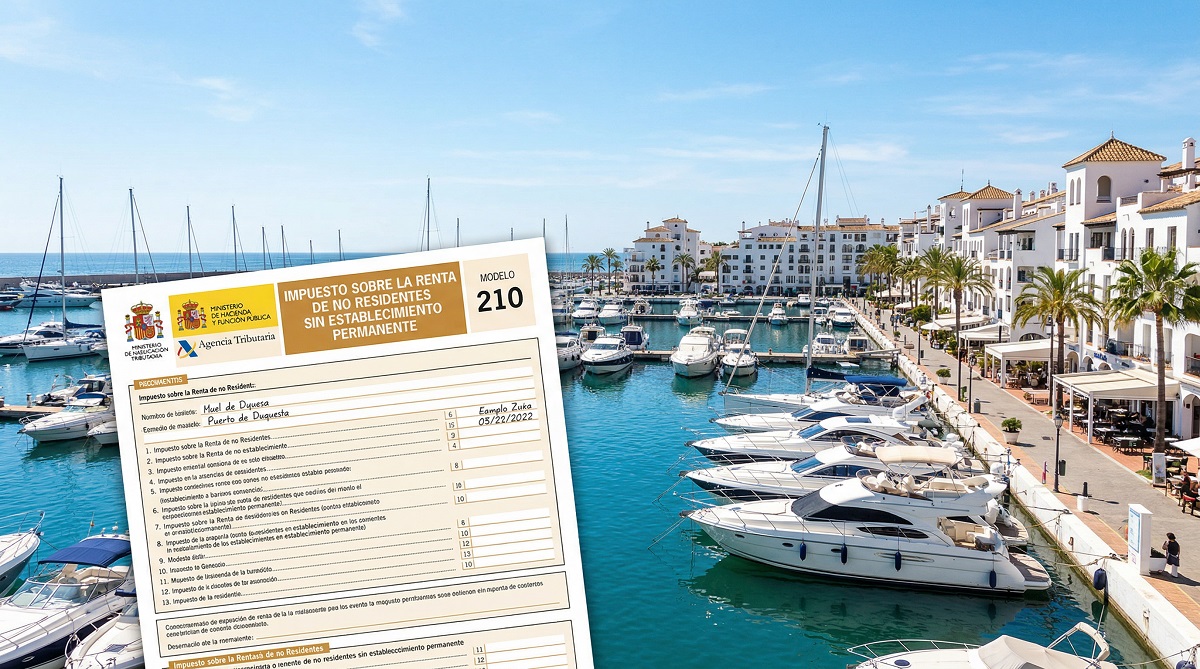
If you own property in Spain but are not a Spanish tax resident, you may be required to file Modelo 210, the Spanish Non Resident Income Tax return.
Missing the filing deadline does not make the tax obligation disappear. Depending on how late the return is filed and whether the Spanish Tax Agency has already contacted you, additional charges, interest or penalties may apply.
The good news is that voluntarily correcting a late Modelo 210 before receiving a formal request from the Spanish Tax Agency can normally result in significantly more favourable treatment than waiting for the authorities to contact you.
This guide explains late filing penalties for Spanish Non Resident Tax, how late payment surcharges work, the Modelo 210 deadlines and what non resident property owners should do if they have missed a tax return.
What Is Modelo 210?
Modelo 210 is the tax form used by non residents to declare certain income obtained in Spain without a permanent establishment.
For foreign property owners, it is commonly used to declare:
Imputed income tax on Spanish property that is available for the owner's personal use
Rental income received from letting a Spanish property
Certain income arising from the sale of Spanish property
Other types of Spanish source income
Even if you do not rent your Spanish property, you may still have a Modelo 210 filing obligation because Spain can impose tax on the deemed or imputed income associated with a property available for your own use.
What Happens If You File Modelo 210 Late?
The consequences depend largely on one important question:
Did you file voluntarily before the Spanish Tax Agency contacted you?
Under Article 27 of Spain's General Tax Law, a taxpayer who voluntarily submits a late tax return before receiving a prior formal request from the tax authorities can generally be subject to a late filing surcharge rather than the sanctions that could otherwise apply.
The surcharge increases according to how late the declaration is filed.
This is one of the most important reasons to correct an outstanding Modelo 210 as soon as you discover it.
Modelo 210 Late Filing Surcharges
Where a tax return with tax payable is submitted voluntarily after the deadline and before a prior request from the Spanish Tax Agency, the general late filing surcharge system is:
Delay after the filing deadline | General surcharge |
|---|---|
Less than 1 complete month | 1% |
1 complete month | 2% |
2 complete months | 3% |
3 complete months | 4% |
4 complete months | 5% |
5 complete months | 6% |
6 complete months | 7% |
7 complete months | 8% |
8 complete months | 9% |
9 complete months | 10% |
10 complete months | 11% |
11 complete months | 12% |
More than 12 months | 15% plus applicable late payment interest |
The rule is essentially 1% plus an additional 1% for every complete month of delay during the first 12 months.
Once more than 12 months have passed, the surcharge becomes 15%. Interest can then also apply for the period beginning after the first 12 months of delay until the late return is filed.
Example
Imagine that your Modelo 210 showed €500 of tax payable and you voluntarily filed it four complete months after the deadline.
A 5% surcharge would generally apply:
€500 × 5% = €25
The underlying €500 tax would still need to be paid.
The exact calculation depends on the filing dates and individual circumstances, so the applicable surcharge should always be checked against the actual deadline for the declaration.
Can the Late Filing Surcharge Be Reduced?
Potentially, yes.
Spanish tax legislation provides for a 25% reduction of the late filing surcharge when the relevant statutory requirements are satisfied, including payment of the remaining surcharge within the required period and payment of the underlying tax debt under the conditions established by law.
This reduction applies to the surcharge itself, not to the original tax liability.
Filing Late Before the Tax Agency Contacts You Is Important
There is an important distinction between:
Voluntary late filing
and
Filing after the Spanish Tax Agency has already started action concerning the outstanding tax.
The favourable late filing surcharge system under Article 27 applies to declarations filed outside the deadline without a prior request from the tax authorities. Spanish legislation defines a prior request broadly and includes formal administrative action aimed at recognising, checking, regularising or assessing the tax debt.
For this reason, ignoring an outstanding Modelo 210 can make the situation more complicated.
If you realise that you have missed a declaration, dealing with it voluntarily is generally preferable to waiting for the Spanish Tax Agency to identify the omission.
What If I Have Not Filed Modelo 210 for Several Years?
This is relatively common among foreign property owners.
Some owners purchase a holiday home in Spain without realising that owning the property can create an annual Non Resident Income Tax obligation even when the property has not been rented.
If you discover that several years of Modelo 210 declarations are outstanding, do not assume that you should simply start filing from the current year.
Your previous tax obligations should be reviewed to establish:
Which tax years are outstanding
Whether the property was rented or used privately during each period
Your percentage of ownership
The property's cadastral value
Whether the cadastral value has been revised
Your country of tax residence
Whether tax was payable for each period
The correct filing deadline for each declaration
Whether any surcharge or interest may apply
Where a property has several owners, each owner's individual filing obligations should also be considered.
What Is the Deadline for Modelo 210?
The filing deadline depends on the type of income being declared.
Imputed Income on Property for Personal Use
For 2025 imputed property income, the filing period runs during the 2026 calendar year, from 1 January until 31 December 2026.
However, an important change applies from the 2026 tax year onwards.
For imputed income corresponding to 2026 and subsequent years, the filing period will run from 1 April until 31 December of the following calendar year.
This means that imputed income relating to 2026 will be filed between 1 April and 31 December 2027.
Rental Income
The rules for rental income have also changed.
Under the changes introduced in 2026, rental income arising from October 2026 onwards that results in tax payable will generally be declared during the first 20 calendar days of April of the following year.
For example, rental income falling under the new rules and earned during 2026 will generally be declared between 1 and 20 April 2027.
There are transitional rules for rental income arising earlier in 2026, so owners should be careful when determining the deadline for that year.
I Did Not Rent My Property. Do I Still Need to File?
Possibly, yes.
This is one of the most common misunderstandings among non resident property owners in Spain.
If you are a non resident individual and own Spanish urban property that is available for your own use, you may have to declare imputed property income, even if:
You never rented the property
You only used it for holidays
The property remained empty
You received no actual income from it
Therefore, "I didn't earn any money from my Spanish property" does not necessarily mean that there is no Spanish Non Resident Income Tax obligation.
What If I Rent the Property for Part of the Year?
A property can potentially have both rental income and imputed income during the same tax year.
For example, suppose you own an apartment on the Costa del Sol and rent it to holidaymakers for 100 days during the year.
You may have to declare rental income relating to the rented period and imputed income relating to the period when the property was available for your personal use.
The calculation therefore needs to take into account the number of days corresponding to each use of the property.
What If There Are Two Owners?
Ownership is another area where mistakes frequently occur.
If a Spanish property is jointly owned by two non resident individuals, each owner normally has their own Spanish tax obligation based on their ownership percentage.
For example, if a married couple owns a property 50% each, the tax calculation generally needs to reflect each person's 50% ownership.
It is therefore important not to assume that one Modelo 210 automatically covers everyone who owns the property.
Common Reasons Foreign Property Owners Miss Modelo 210
Late filing does not always result from deliberately avoiding Spanish tax.
Many international property owners simply do not know about the obligation.
Common reasons include:
Believing no tax is due because the property is not rented
Assuming IBI council tax covers all Spanish property taxes
Thinking the community fees include property taxes
Believing the lawyer who handled the purchase automatically files future tax returns
Moving abroad and forgetting about the annual declaration
Missing a filing deadline
Not knowing that each co owner may have a separate obligation
Confusing Modelo 210 with IBI or another Spanish tax
Not knowing that different deadlines can apply to rental and imputed income
Whatever the reason, discovering an old tax obligation should normally prompt a review rather than further delay.
Is Modelo 210 the Same as IBI?
No.
IBI and Modelo 210 are different taxes.
IBI, Impuesto sobre Bienes Inmuebles, is a municipal property tax generally charged by the local town hall.
Modelo 210 is used for Spain's Non Resident Income Tax, IRNR, administered by the Spanish Tax Agency.
Paying your annual IBI bill therefore does not automatically mean that your Non Resident Income Tax obligations have been fulfilled.
Should I Wait for the Spanish Tax Agency to Contact Me?
Generally, voluntarily correcting an outstanding declaration before receiving a formal tax authority request can be important because Article 27 provides a specific surcharge regime for late declarations submitted without prior request.
Waiting can therefore be counterproductive.
If you know that a Modelo 210 declaration is outstanding, it is worth establishing the correct tax year, tax liability and filing deadline as soon as possible.
How to Correct a Late Modelo 210
If you have missed the deadline, the first step is to determine exactly what should have been declared.
You will normally need information such as:
Your NIE number
Property details
Cadastral reference
Cadastral value
Ownership percentage
Purchase or ownership dates
Country of tax residence
Rental income, if applicable
Relevant expenses where deductible
Periods of private use and rental use
The late declaration can then be calculated and submitted for the correct tax period.
The Spanish Tax Agency has a specific administrative procedure for assessing surcharges arising from declarations and self assessments filed outside their statutory deadlines.
Do Not Ignore an Overdue Spanish Non Resident Tax Return
If you have missed your Spanish Non Resident Income Tax deadline, the most important thing is not to ignore it.
The Spanish system provides a mechanism for taxpayers who voluntarily correct late declarations before receiving a prior request from the authorities. The applicable surcharge generally increases as the delay becomes longer, reaching 15% after more than 12 months, after which interest may also apply.
Correcting an outstanding Modelo 210 sooner can therefore help prevent the situation from becoming more expensive or complicated.
File Your Spanish Non Resident Tax Online with EasySpanishTax
Owning property in Spain should not mean struggling with complicated Spanish tax forms.
At EasySpanishTax, we make it easier for foreign property owners to prepare and file their Spanish Non Resident Income Tax declarations.
Whether you need to declare imputed property income, rental income, or need to deal with an outstanding Modelo 210 from a previous year, our online service guides you through the information required to prepare your Spanish tax declaration.
Have you missed a Modelo 210 deadline?
Do not leave an outstanding Spanish tax return unresolved. Start your declaration with EasySpanishTax and make sure the correct property, ownership and tax period information is used.
Start your Spanish Non Resident Tax declaration today with EasySpanishTax.com.
This article provides general information about Spanish taxation and should not be considered individual tax or legal advice. Tax treatment depends on the circumstances of each taxpayer.