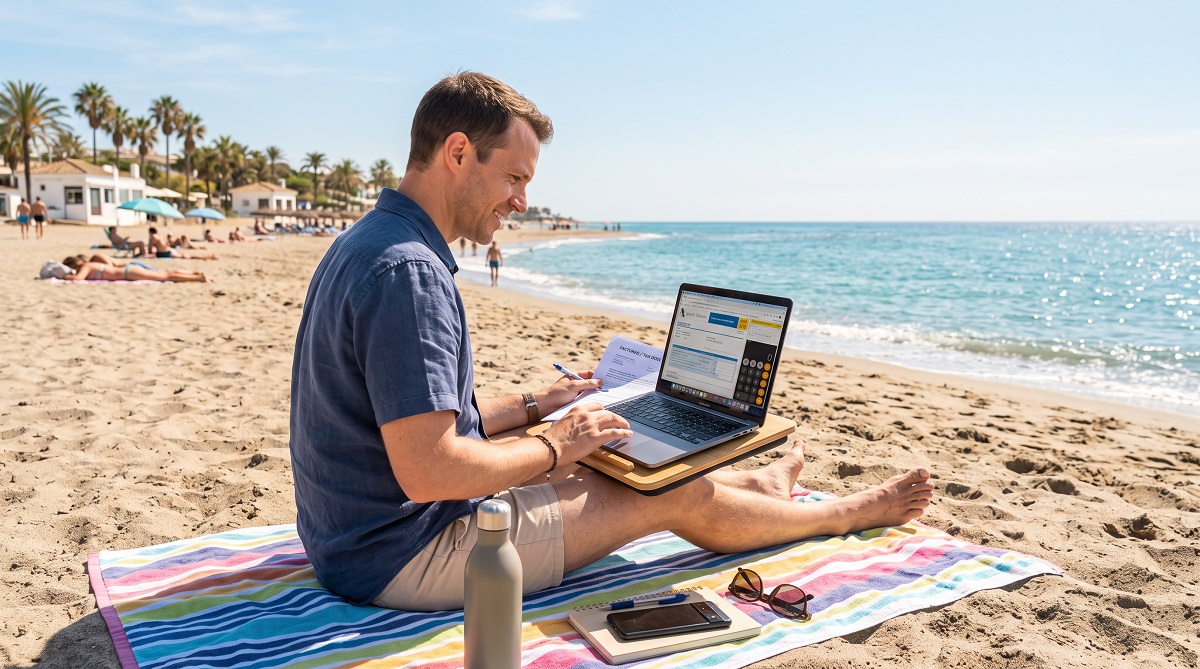
Moving to Spain, spending long periods at a holiday home or working remotely from the Spanish coast can have important tax consequences.
One of the first questions to understand is whether you are considered a tax resident in Spain or a non-resident.
This distinction matters because Spanish tax residents are generally taxed through the Spanish Personal Income Tax system, known as IRPF, while non-residents are normally taxed only on certain income and assets connected to Spain.
Many people believe that tax residency depends only on spending more than 183 days in Spain. The number of days is important, but it is not the only test. You may become a Spanish tax resident because your main economic interests are in Spain, even when you spend fewer than 184 days in the country.
This guide explains the main Spanish tax residency rules, how the 183-day test works and what becoming a resident could mean for your tax obligations.
What Is Tax Residency in Spain?
Tax residency determines the country in which you are treated as resident for tax purposes.
It is different from:
Immigration status
Nationality
Owning a Spanish property
Holding an NIE number
Being registered on the local padrón
Having a Spanish residence permit
You can legally reside in Spain without automatically becoming tax resident immediately. Equally, obtaining a visa or residence card does not by itself decide your final tax position.
Spanish tax residency is determined mainly by the circumstances set out in Article 9 of the Spanish Personal Income Tax Law. Under these rules, an individual is generally considered tax resident in Spain when at least one of the principal residency tests is met.
The Three Main Tests for Spanish Tax Residency
You may be considered a Spanish tax resident when any of the following applies:
You spend more than 183 days in Spain during a calendar year.
Your main centre or base of economic activities or interests is located in Spain.
Your spouse and dependent minor children normally live in Spain, subject to the possibility of proving otherwise.
You do not necessarily need to meet all three conditions. Meeting one may be enough for Spain to consider you tax resident.
The 183-Day Rule in Spain
The best-known Spanish tax residency test is the 183-day rule.
You will generally be considered tax resident in Spain when you remain in Spanish territory for more than 183 days during the same calendar year.
The Spanish tax year follows the calendar year, running from 1 January to 31 December.
For example, imagine that you arrive in Spain on 1 March and remain continuously until the end of the year. You would normally exceed 183 days in Spain and could become tax resident for that calendar year.
The rule refers to more than 183 days. Therefore, the usual threshold is reached from day 184.
However, simply counting nights at your Spanish property may not provide a complete answer.
Do the 183 Days Need to Be Consecutive?
No. The days do not need to be consecutive.
Separate stays during the year can be added together.
For example, suppose you spend:
90 days in Spain during spring
60 days during summer
40 days during winter
Your total stay would be 190 days. Although none of the visits individually lasted more than 183 days, their combined duration could make you tax resident in Spain.
Do Travel Days Count?
Days of physical presence may be relevant when calculating how long you have spent in Spain. Entry and departure records, travel bookings, utility consumption and card transactions may all help establish where you were during a particular period.
People who divide their time between several countries should keep reliable evidence of their movements rather than relying on estimates.
Useful evidence can include:
Flight and ferry tickets
Passport records
Hotel invoices
Employment records
Bank and card transactions
Utility bills
Mobile telephone records
Calendar entries and appointment records
No single document necessarily decides residency. The overall circumstances and supporting evidence are important.
What Are Sporadic Absences?
A common misunderstanding is that every day spent outside Spain must automatically be deducted from the calculation.
Under Spanish rules, certain sporadic absences may still be taken into account when determining whether the 183-day threshold has been exceeded, unless the taxpayer proves tax residence in another country.
Where the claimed country of residence is a jurisdiction treated under Spain’s special rules for non-cooperative jurisdictions, the Spanish Tax Agency may demand stronger proof of actual presence there.
This means that briefly travelling outside Spain does not always guarantee that those days will be excluded.
For example, taking several short holidays in Portugal, France or the United Kingdom may not automatically prevent Spanish tax residency when Spain continues to be your real base.
Can You Become Tax Resident Without Spending 184 Days in Spain?
Yes.
The 183-day rule is only one part of the residency test.
You may also become tax resident when the main centre or base of your economic activities or interests is in Spain, directly or indirectly.
This test can be particularly important for:
Business owners
Company directors
Self-employed professionals
Property investors
Remote workers
People whose principal income-producing activities are based in Spain
Consider someone who spends 170 days in Spain but manages their main business from a Spanish office, receives most of their income through Spanish activities and has their principal investments in Spain.
Although the person has not exceeded 183 days, Spain may still argue that the centre of their economic interests is located in Spain.
There is no single percentage that automatically determines the centre of economic interests. The authorities may examine the full situation, including where a business is managed, where income is generated and where the person’s principal financial activities are located.
The Family Presumption
Spanish law also contains a rebuttable presumption relating to family residence.
Unless evidence indicates otherwise, a person may be presumed resident in Spain when their spouse, from whom they are not legally separated, and their dependent minor children habitually live in Spain.
This does not mean that every person whose family lives in Spain is automatically tax resident. However, it may be an important factor, particularly when the person claims to live abroad while their immediate family and permanent home remain in Spain.
The presumption can be challenged with appropriate evidence, such as proof of tax residence, work and normal life in another country.
Is Owning Property in Spain Enough to Make You Tax Resident?
No. Owning a property in Spain does not by itself make you a Spanish tax resident.
Many foreign owners legally hold apartments, villas and holiday homes in Spain while remaining tax resident elsewhere.
However, property ownership can form part of the overall evidence considered when determining where your permanent home and personal interests are located.
A person who owns a holiday apartment, visits for eight weeks each year and has their family, employment and principal home abroad will normally be in a very different position from someone who spends most of the year at their Spanish home and conducts their normal life from Spain.
Even when you remain non-resident, owning property in Spain can create Spanish tax obligations. These may include Non-Resident Income Tax declared through Modelo 210, tax on Spanish rental income, local IBI property tax and taxation on a future property sale.
Does an NIE Make You Tax Resident?
No.
An NIE, or Número de Identidad de Extranjero, is an identification number for foreigners dealing with Spanish authorities and institutions.
It is commonly needed when buying a property, opening a bank account, paying taxes, arranging utilities or completing legal transactions.
Receiving an NIE does not determine your tax residency.
Does Registering on the Padrón Make You Tax Resident?
Registration on the municipal padrón is not, by itself, conclusive proof of Spanish tax residency.
However, it can be relevant evidence of where you live. The Spanish Tax Agency may consider it together with other facts, including the number of days spent in Spain, housing arrangements, family location and economic interests.
The same principle applies to Spanish residence permits and visas. They concern immigration rights, whereas tax residency is decided under tax law and any applicable international tax treaty.
What Happens When You Become Tax Resident in Spain?
Once you become a Spanish tax resident under the ordinary rules, you will generally be subject to Spanish Personal Income Tax on your worldwide income.
This can include income received from both Spain and other countries, such as:
Employment income
Pensions
Rental income
Self-employment or business income
Dividends
Interest
Investment gains
Capital gains
The Spanish Tax Agency confirms that Spanish tax residents generally declare worldwide income, subject to the terms of any applicable double taxation agreement.
Becoming resident does not necessarily mean paying tax twice on the same income. Spain has double taxation agreements with many countries, and Spanish domestic legislation also contains mechanisms that may allow relief for foreign taxes.
The exact treatment depends on the type of income, its country of origin and the relevant tax treaty.
Could You Need to Report Foreign Assets?
Spanish tax residents may also have reporting obligations relating to certain assets and rights held outside Spain.
Modelo 720 is the Spanish information return concerning certain foreign bank accounts, investments, insurance products, property and property rights. It is an information declaration rather than a tax bill, but it can be an important compliance requirement for people who move to Spain with assets abroad.
Whether you must submit Modelo 720 depends on the type and value of your foreign assets, your tax status and whether an exemption applies.
The rules should be checked carefully because different asset categories are considered separately. For example, the relevant reporting threshold may be assessed independently for foreign bank accounts, investments and overseas property. Official guidance illustrates a threshold of €50,000 within the relevant category in determining an initial reporting obligation.
Foreign cryptocurrency reporting is dealt with separately and is not included in Modelo 720.
Can You Be Tax Resident in Two Countries?
It is possible for two countries’ domestic laws to initially treat the same person as tax resident.
For example, you might exceed Spain’s 183-day threshold while maintaining a home or other important connections in your previous country.
When Spain and the other country have a double taxation agreement, the treaty normally contains “tie-breaker” rules to determine residency for treaty purposes.
These rules commonly consider, in order:
Where you have a permanent home available
Where your personal and economic relationships are closer, known as the centre of vital interests
Where you habitually live
Your nationality
An agreement between the tax authorities if the earlier tests do not resolve the issue
These criteria are applied in sequence rather than simply choosing the country with the lower tax rate.
What Is the Centre of Vital Interests?
The centre of vital interests is used mainly when a person has a permanent home available in both countries.
It looks at where the person has their closest personal and economic relationships.
Relevant factors may include:
Where the immediate family lives
Where the main home is located
Where the person works or manages a business
Where their principal income arises
Where their social and professional life is based
Where their main investments and financial arrangements are held
No individual factor always decides the outcome. The entire factual situation must be considered.
How Can You Prove Tax Residence in Another Country?
A tax residence certificate issued by the foreign tax authority is one of the most important forms of evidence.
The certificate should normally confirm that you are tax resident in that country under its domestic law and, where appropriate, under the relevant double taxation agreement.
Bank statements, employment documents, housing records and travel evidence may also be useful.
Spain also issues tax residence certificates where the information held by the Spanish Tax Agency supports the applicant’s Spanish tax residence.
A certificate is valuable evidence, but residency disputes can still require examination of the underlying facts.
What If You Move to Spain Partway Through the Year?
Spain generally assesses individual tax residency by reference to the calendar year.
You should therefore carefully count the days spent in Spain during the year of your move and consider whether the economic-interest or family tests also apply.
For example, a person arriving on 1 September will not normally reach 184 days before 31 December. However, their wider circumstances should still be reviewed.
A person arriving earlier in the year may pass the day-count test and become resident for that tax year.
Special situations, including treaty issues and Spain’s special tax regime for certain people moving to the country, require separate analysis.
What Is the Beckham Law?
The commonly named “Beckham Law” is a special Spanish tax regime for certain individuals who move to Spain.
Despite its nickname, it is not limited to professional athletes. The regime may be available to qualifying employees, remote workers, entrepreneurs, professionals and certain family members, provided the legal conditions are met.
Since 1 January 2023, eligibility has been expanded to include additional categories, including certain remote workers, entrepreneurs and qualified professionals involved in innovation-related activities.
Qualifying individuals become Spanish tax residents but may elect to be taxed under special rules based largely on the Non-Resident Income Tax framework.
The regime can apply for the tax year in which Spanish tax residence is acquired and the following five tax years.
An application is required, and strict eligibility requirements and deadlines apply. Becoming resident does not automatically place someone under this special regime.
Tax Resident Versus Non-Resident in Spain
The main distinction can be summarised as follows:
Spanish tax resident
A resident will generally:
File under Spanish Personal Income Tax rules
Declare worldwide income, subject to treaty provisions
Potentially have foreign-asset reporting obligations
Be assessed according to the rules applicable in their autonomous community where relevant
Spanish non-resident
A non-resident will generally:
Pay Spanish tax only on Spanish-source income and certain Spanish assets
Use Modelo 210 for many non-resident income declarations
Declare Spanish rental income when applicable
Potentially pay imputed income tax on a Spanish property that is not rented
Pay tax on gains from selling Spanish property
The correct category depends on your actual situation, not simply on how you describe yourself.
Common Tax Residency Mistakes
Assuming that fewer than 183 days always means non-resident
You may still become resident if your main economic interests are in Spain.
Counting only uninterrupted stays
Separate visits during the same calendar year can be added together.
Ignoring sporadic absences
Short trips abroad may not automatically interrupt Spanish presence for tax purposes.
Confusing immigration residence with tax residence
A residence permit, NIE or padrón registration does not independently decide tax residency.
Believing property ownership creates residency
Owning a holiday home alone does not make you resident, although it may create non-resident tax obligations.
Ignoring foreign income after becoming resident
Spanish residents are generally taxed on worldwide income, subject to treaty rules and available double-taxation relief.
Assuming a foreign tax return settles the matter
Filing tax in another country does not automatically prevent Spain from considering you resident. Domestic legislation and treaty rules must be applied.
Practical Example: Spending Winters in Spain
Consider a retired couple who own an apartment on the Costa del Sol.
They spend January to April and October to December in Spain. Their total stay is approximately seven months.
Even though they describe the property as a holiday home, they have exceeded 183 days and are likely to meet Spain’s physical-presence test.
Their pensions, investments and other worldwide income may therefore need to be considered under Spanish resident tax rules and the tax treaty between Spain and their former country of residence.
Practical Example: Fewer Than 183 Days but a Spanish Business
Suppose a business owner spends 170 days in Spain.
They own and actively manage a Spanish company, conduct most of their work from Spain and receive the majority of their income from the Spanish business.
Although the person has stayed fewer than 184 days, the Spanish Tax Agency could examine whether their main centre of economic interests is in Spain.
Practical Example: A Foreign Holiday-Home Owner
A Swedish resident owns a holiday apartment in Málaga and visits Spain for ten weeks each year.
Their permanent home, family, employment and principal financial interests remain in Sweden.
On those facts, the owner would not normally become Spanish tax resident merely because they own the Málaga property.
However, they may still need to file Modelo 210 and pay Spanish non-resident property tax even when the apartment is not rented.
How to Avoid Tax Residency Problems
People spending significant time in Spain should review their position before the end of the calendar year.
A practical approach is to:
Keep an accurate record of travel days
Retain evidence of where you live and work
Obtain a tax residence certificate where appropriate
Review the location of your family and economic interests
Check the relevant double taxation agreement
Review Spanish filing obligations before moving
Avoid relying only on the 183-day rule
Seek individual advice when your circumstances involve two countries
Planning before a move is usually easier than correcting tax returns after residency has been challenged.
Does EasySpanishTax Handle Resident Tax Returns?
EasySpanishTax.com is designed primarily for non-resident property owners in Spain, particularly owners who need to file Modelo 210.
If you remain tax resident outside Spain and own a Spanish apartment, villa or holiday home, our online service can help simplify your non-resident property tax declaration.
If your circumstances indicate that you may have become Spanish tax resident, you should establish your residency position before submitting a non-resident return. Spanish residents normally have different filing obligations and should not automatically continue filing as non-residents.
Frequently Asked Questions About Spanish Tax Residency
How many days can I stay in Spain without becoming tax resident?
You will not normally meet the physical-presence test unless you spend more than 183 days in Spain during the calendar year. However, you may still become resident if your main economic interests are in Spain or the family presumption applies.
Is it 183 days or 184 days?
Spanish law refers to remaining in Spain for more than 183 days. In practical terms, this means reaching at least 184 days during the calendar year.
Do weekends and holidays count?
Days physically spent in Spain can form part of the calculation, whether they are working days, weekends or holidays.
Can I leave Spain for short trips to avoid tax residency?
Short trips abroad may not be enough. Sporadic absences can be included unless you prove tax residence in another country.
Does buying a house make me a Spanish tax resident?
No. Property ownership alone does not establish Spanish tax residency.
Does a Spanish residence visa make me tax resident?
Not automatically. Immigration residence and tax residence are separate legal concepts.
Can I remain tax resident in the United Kingdom after moving to Spain?
Possibly, depending on UK domestic rules, Spanish domestic rules and the Spain–UK double taxation agreement. When both countries initially treat you as resident, the treaty tie-breaker provisions must be considered.
Do I pay tax twice if both countries treat me as resident?
Double taxation agreements and domestic tax credits are intended to prevent or reduce double taxation. However, you may still have reporting obligations in both countries.
Do Spanish tax residents declare foreign pensions?
Spanish residents generally declare worldwide income, including foreign pensions, although the applicable treaty may determine where a particular pension is taxable.
Can married couples have different tax residencies?
Yes, depending on their individual circumstances. However, the residence of a spouse and dependent children can be relevant under the Spanish family presumption and treaty tests.
How do I prove that I am not tax resident in Spain?
Evidence may include a foreign tax residence certificate, travel records, proof of a permanent home abroad, employment records and documents demonstrating that your personal and economic life is centred outside Spain.
The Spanish 183-day rule
The Spanish 183-day rule is important, but it is not the whole story.
You may become tax resident in Spain because:
You spend more than 183 days in the country
Your principal economic interests are located in Spain
Your immediate dependent family lives in Spain and the legal presumption is not rebutted
When two countries claim you as resident, the relevant double taxation agreement may determine your final treaty residence using permanent-home, centre-of-vital-interests, habitual-abode and nationality tests.
Becoming a Spanish tax resident can change how your salary, pension, rental income, investments and overseas assets are reported. It is therefore important to examine your position before moving permanently or spending extended periods in Spain.
If you remain a non-resident and own property in Spain, EasySpanishTax.com provides a straightforward and affordable way to complete your Modelo 210 declaration online.
File your Spanish non-resident property tax online with EasySpanishTax.com and avoid unnecessary paperwork, appointments and expensive annual administration.
Online Tax Filing vs Gestor: Which Is Better?
This article provides general information and does not replace personalised tax or legal advice. Tax residency depends on individual circumstances and the applicable legislation and tax treaty.